
How to Get Into Digital Marketing (2026 Career Pivot Guide)
 By Stephen Pedder
 To enter digital marketing, choose a specialization, develop core skills through hands-on projects, and connect with other industry professionals. Invest in long-term learning. In a constantly evolving industry, staying up to date will help you stand out from the competition.
Digital marketing is one of the few industries where a data analyst, a creative director, and a brand strategist can all thrive and have the same job title. It’s also one of the most pivot-friendly careers.
As marketing recruiters, we’ve placed fresh grads and career shifters from every background imaginable. That means we know exactly what it takes to make the switch.
In this guide, we’ll help you dissect how to get into digital marketing: what to learn, what to skip, and how to get hired faster. Spoiler alert: that’s through a specialized recruiter like Ad Culture!
Is Digital Marketing Still a Good Career Option in 2026?
Yes, digital marketing is still a great career option, with steady hiring demand and continued growth in digital ad spending, which reached $294.6B in 2025. Around 73.8% of the world is online, so businesses of every size are expanding their digital presence to better reach their markets.
However, employers in the US and Canada are seeking more specialized skills, such as analytics, search engine optimization (SEO), paid media, AI marketing, and automation. Many agencies and in-house teams are restructuring their marketing teams to keep up with changing consumer behavior (and emerging tools) online.
At Ad Culture, we’ve seen significant changes in the names, job roles, and tools for digital marketing roles over the past year to reflect new demands. But one thing hasn’t changed: skilled digital marketers are still in high demand.
If you’ve been figuring out how to get into digital marketing for a while, you may have heard the industry is oversaturated. It is, but only at the generalist level. Many of the employers we work with are looking for highly specific, often niche, skills and expertise. So, pro tip: specialize early and build real proof of your work.

Source: Pexels
Best Digital Marketing Jobs to Target
The roles with the strongest hiring demand right now are in paid media, SEO, marketing automation, and analytics. Brands and agencies are hiring fewer generalists and more specialists who can directly influence growth.
Here are the best jobs in digital marketing to apply for:
| Role | What They Do | Top Skills | Salary Range | Demand |
| Performance Marketing Specialist
Also: Paid Media Manager |
Manages paid acquisition across Google, Meta, LinkedIn, and programmatic platforms.
Focus on testing, optimization, and measurable ROI. |
Google Ads, Meta Ads, bid strategy, A/B testing, analytics | CA C$60K–C$130K
US $58K–$145K USD |
Very high |
| SEO Specialist
Also: Growth Strategist |
Optimizes websites and content for search visibility.
Requires technical fluency, content strategy, and understanding of AI-driven search. |
Technical SEO, keyword research, GA4, content strategy, AI search | CA C$47K–C$91K
US $56K–$115K USD |
Very high |
| Marketing Automation Specialist
Also: Client Relationship Management (CRM) Specialist |
Builds and manages Client Relationship Management (CRM) workflows, email sequences, and lead nurturing programs.
One of the hardest roles to fill in both markets. |
HubSpot, Salesforce, Marketo, segmentation, data analysis | CA C$60K–C$100K
US $65K–$120K USD |
Very high |
| Digital Marketing Analyst
Also: Marketing Data Analyst |
Interprets campaign data and translates it into strategy and decisions.
Data literacy is now expected at every level. |
GA4, Looker Studio, Excel, attribution modeling, reporting | CA C$55K–C$95K
US $64K–$115K USD |
High |
| Social Media Manager
Also: Content Strategist |
Manages organic brand presence and content strategy across platforms.
High demand in consumer-facing industries and agencies. |
Content planning, copywriting, platform analytics, community management | CA C$73K–C$97K
US $50K–$100K USD |
High |
| AI Marketing Specialist
Also: AI Marketing Manager |
Integrates AI tools into campaign workflows, content production, and performance reporting.
Growing fast with very few qualified candidates. |
Prompt writing, ChatGPT, Jasper, AI analytics, automation | CA C$65K–C$110K
US $70K–$130K USD |
Emerging |
|
Sources: Canadian Job Bank, Glassdoor, Indeed. Ranges reflect from specialist to manager level. |
||||
How to Start a Career in Digital Marketing
To start a career in digital marketing, you mainly need a specialization, the right certifications, hands-on experience, a portfolio, and a network that opens doors.
Here’s how to get all five:
1. Choose a Specialization
Before you learn anything, decide what kind of digital marketer you want to be. Digital marketing encompasses a wide range of specializations: SEO, paid media, content, social, email, analytics, and automation, each one vastly different from the next.
Start with what you already do well:
| If you’re good at… | Specialize in… |
| Analytics, numbers, and data interpretation | Paid media or marketing analytics |
| Writing, storytelling, or teaching | SEO or content marketing |
| Creative thinking and platform trends | Social media marketing |
| Systems, processes, and automation | Marketing automation or CRM |
| Design and visual communication | Social media, content production, or UX-adjacent roles |
| Sales and persuasion | Paid media, conversion strategy, or CRM |
→ Not sure where to start? Our digital marketing career path guide helps you map your existing background to the right track.
2. Take Online Courses and Certifications
If your field is a complete 180 from digital marketing, you may need to take foundational digital marketing courses or consider a diploma program to build your base.
But in most cases, a focused certification from a recognized platform is enough to get your foot in the door. Start with Google, HubSpot, and Meta, then add an AI certification to stand out in 2026.
Here are some of the best comprehensive programs many employers recognize:
| Digital Marketing Certifications | Provider | Cost | Best For |
| Google Ads (Search, Display, Video) | Google Skillshop | Free | Paid media roles |
| GA4 (Google Analytics 4) Certification | Google Skillshop | Free | All roles |
| HubSpot Inbound Marketing | HubSpot Academy | Free | Content, CRM, agency |
| Meta Blueprint | Meta | Free to $150 | Paid social roles |
| LinkedIn Marketing Solutions | LinkedIn Learning | Free | B2B marketing |
| SEMrush SEO Toolkit | SEMrush Academy | Free | SEO roles |
| Generative AI for Marketers | Google / HubSpot | Free | All roles |
3. Build Key Skills
Next, upskill for your chosen track. If you’re pivoting into social media marketing, build skills in platform-specific algorithms, content calendar management, paid social basics, and analytics.
Brush up on key general skills, too. Most roles we come across require at least a working knowledge of:
- Data and analytics: reading dashboards, interpreting campaign performance, and making decisions from numbers
- AI tools: using ChatGPT, Jasper, or platform-native AI features in digital marketing campaigns + day-to-day work
- Copywriting: writing clearly and persuasively across channels, from ad copy to email subject lines
- SEO basics: understanding how content gets found, even if SEO isn’t your primary specialization
- Platform fluency: knowing how major digital marketing channels and social media platforms work, including their algorithms and best practices
- Strategic thinking: connecting digital marketing efforts to business goals
| Pro tip: Before you apply anywhere, pull up a few job postings for your target role/company and review the tools and skills they’re asking for. That should give you an idea where to focus your upskilling. |
4. Leverage Your Existing Experience
Career shifters don’t need to start from zero. Your previous experience is an asset; you just need to reframe it. The trick is translating what you’ve done into marketing language.
Let’s say you’re a teacher who wants to do SEO:
- Lesson planning = content structuring
- Explaining complex topics = search intent
- Tracking student progress = keyword research and monitoring
The tools are new, but the underlying way of thinking already fits the role. The same logic applies across most backgrounds:
| Your Background | Where It Translates |
| Sales | Paid media, conversion strategy, CRM |
| Communications/PR | Content marketing, social media, brand |
| Finance or data | Analytics, marketing automation, reporting |
| Design | Social media, content creation, UX-adjacent roles |
| Education | SEO, content strategy, email marketing |
| Project management | Marketing operations, campaign management |
✨Still not sure if you’re ready to make the move? Read our guide on signs you’re ready for a digital marketing career.
5. Build a Portfolio and a Personal Brand
In digital marketing, results speak louder than credentials. When we submit a candidate to a client, the first thing hiring managers ask for is work samples. Employers want to see how you think and what you can do.
If something from your past work translates (i.e., a presentation, a campaign, a data report, a research project, a graphic), include it. If not, try building a small project from scratch. You’ll get a portfolio piece out of it, and confirm if this kind of work is what you want to do every day.
Here are six projects you can start this week with little to no budget:
- Run a small Google or social media advertising campaign: Even $50 in spend counts. Document your strategy, measure campaign performance, and screenshot everything.
- Write and publish an SEO-optimized article: Pick a real keyword, write something genuinely useful, and track where it ranks over 60 to 90 days.
- Audit a brand’s social or SEO presence: Choose a brand you know well and write up what you’d change and why. This shows strategic thinking better than almost anything else.
- Build a content calendar: Create a full month of content for a real or mock brand. Include the rationale behind each post, not just the ideas.
- Freelance for a local business: Offer to run a small campaign in exchange for documented results and a testimonial.
- Clean up your LinkedIn: Your headline, summary, and featured section together are a portfolio piece. If it still describes your old career, that’s the first thing to fix.
Pro tip: If you’re just starting out, internships and volunteer work are a legitimate way to get your first real project under your belt. Once you have a few certifications and portfolio pieces to your name, don’t undersell yourself: start charging for your work.
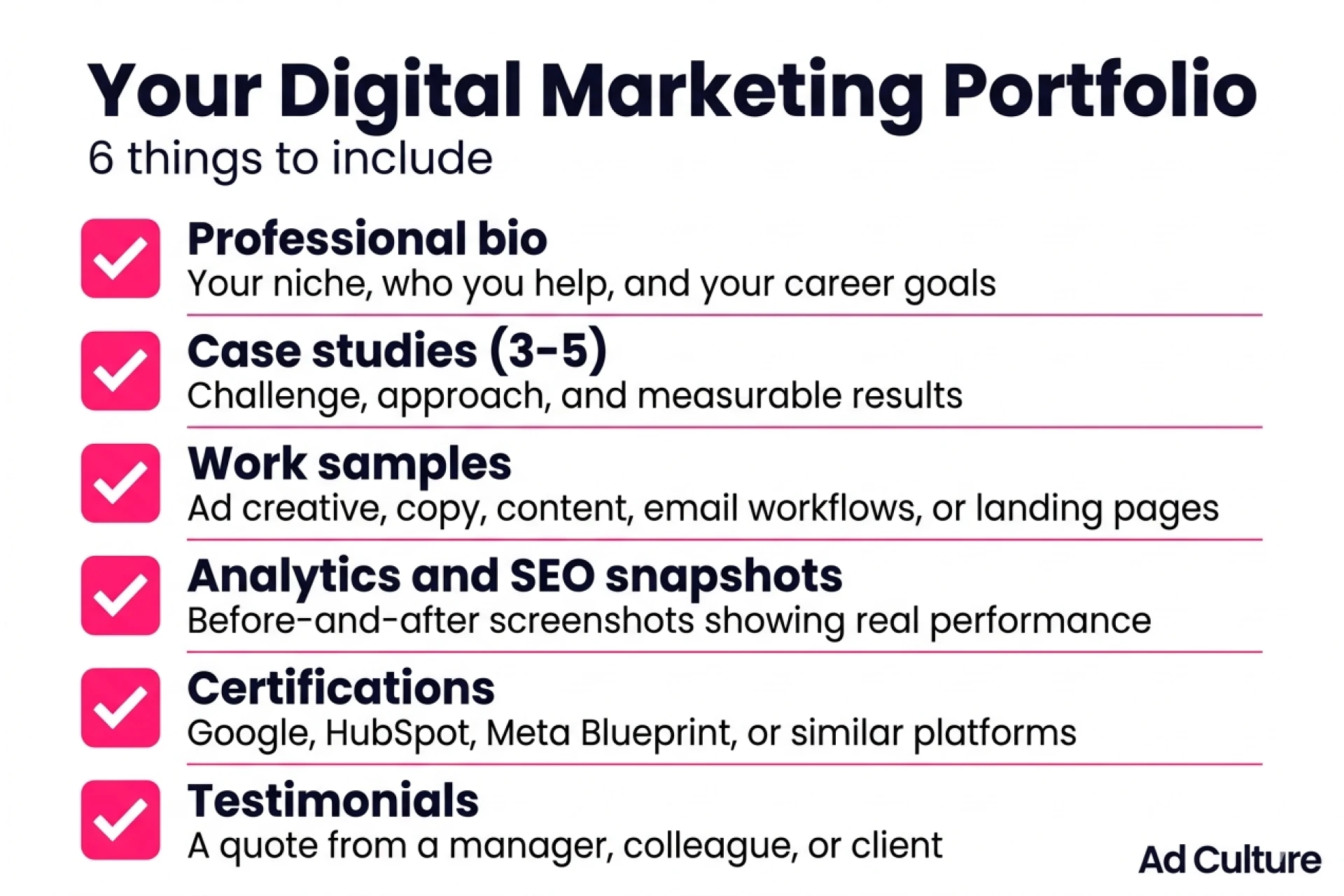
Image Source: Gemini 2026
6. Network and Apply Strategically
Many digital marketing roles never make it to Indeed because companies often fill them through referrals, specialized recruiters, internal hiring, and direct networking. The best way to get into digital marketing is to get in with the right people.
Where to start:
- LinkedIn. Follow the agencies and brands you want to work for, engage with their content, and connect directly with marketers in your specialization
- Industry events. In-person connections tend to stick more than online ones; look for local marketing meetups, conferences, and association events in your city
- Informational interviews. Ask to speak with someone already doing the role you want. Most people are happy to give 20 minutes, and it’s often how positions get filled quietly
Be selective when applying. Filter by specialization, read the job description carefully, and tailor your applications as needed. Spraying applications and hoping for the best produces low response rates and eats up time you could spend building skills.
On remote roles: Many digital marketing positions (especially in SEO/AEO, paid media, and analytics) are remote or hybrid. You’re likely competing with a wider pool that goes beyond your city. If you’ve been job hunting locally and not getting traction, widening your search geographically is often the move.
7. Work With a Specialist Recruiter
Specialized marketing recruiters like Ad Culture focus exclusively on marketing talent and often have access to roles that never reach public job boards. They understand what companies are hiring for, which skills are in demand, and how to position candidates effectively.
If you’re unsure how to market yourself to brands or agencies, a recruiter can break down where you stand and how to get into digital marketing with your background.
They can help:
- Review and strengthen your resume and positioning
- Prep you for interviews
- Show you what roles are actually paying (salary benchmarking)
- Connect you with unadvertised roles
- Give feedback on your portfolio or skill gaps
- Match you to roles that fit your experience and goals
Let’s chat
about building
your team!
FAQs
Potential employers have different job requirements, but most want platform certifications (Google, HubSpot, Meta), hands-on experience, and a portfolio that shows real results.
The main specializations are SEO or AEO (answer engine optimization), paid media, content marketing, social media, email, conversion rate optimization (CRO), and analytics. Pick one, go deep, and upskill from there.
Most digital marketing projects would require practical experience with analytics tools, paid advertising platforms, SEO tools, automation software, content management systems, and project management tools.
No. AI is automating repetitive tasks, not strategic thinking, creative judgment, or client communication. Digital marketers are still the ones setting strategy, interpreting results, and making the calls that move a brand forward.
Yes! Most people who pivot into digital marketing don’t come from a marketing background. Start with free certifications, build a portfolio through personal projects, and get in front of a specialist recruiter to shortcut the learning curve and get your resume in front of the right people.
Key Takeaways
- Digital marketing is still a strong career choice in 2026. To progress as an expert, you need to specialize in a handful of disciplines rather than trying to learn everything at once.
- The highest-demand roles are in paid media, SEO, marketing automation, and analytics.
- To get hired, you need certifications, a portfolio, and a good network. Practical experience, even from small projects, matters more than waiting for the “perfect” role.
- The industry changes quickly, so staying updated is part of the job, not an optional extra.
- Your existing background is an asset; you just need to reframe it in marketing language.
- Working with a specialist recruiter like Ad Culture shortens the path from pivot to placement.
Get Into Digital Marketing Faster With the Right Support
Certifications and courses build foundational skills, but they won’t guarantee interviews, much less offers. The fastest way to figure out how to get into digital marketing (and actually land a role) is to work with people who place marketers every day.
Instead of sending out dozens of applications to random job listings, work with Ad Culture. We’re a specialized recruitment agency that connects quality talent with top digital marketing companies in North America.
Contact our hiring managers today and submit your resume to get access to digital marketing opportunities.