
How Do Recruitment Agencies Work? The Complete Guide to Hiring and Getting Hired
 By Stephen Pedder
 Recruitment agencies help employers find vetted candidates via discovery (job postings/ads), sourcing, screening, interviewing and offer. They save employers time and help job seekers find better-fit roles faster through resume review, interview prep, and career coaching.
You want your business to succeed. To make that goal materialize, you’re going to have to ensure that you’re hiring the best possible candidates for the job, and that’s where recruitment agencies come in to connect you with the right people.
But just how do recruitment agencies work? At Ad Culture, we run our own version of this: a five-step process built around Discovery Call, Role Exploration, Review Existing Database & Contacts, Outreach & Headhunt New Prospects, and Interview & Mini Project.
Here’s how it aligns with the stages below.
What Is a Recruitment Agency?
A recruitment agency is a third party that finds and vets job candidates on behalf of a company, then hands over a shortlist for the employer to choose from. In practice, that looks different depending on which side of the table you’re on.
For employers, it means writing job posts, sifting through resumes, and running first-round interviews, so the only candidates you see are ones who actually match what you’re looking for.
For job seekers, it means having your skills and goals matched to open roles, including those that never get publicly posted, and getting your resume in front of employers who are actively hiring.
Not every recruitment agency works the same way, though. The right fit depends heavily on what (or who) you’re hiring for, and that’s where the difference between a marketing recruitment agency and a general staffing firm starts to matter.
Marketing Recruitment Agencies vs. General Staffing Firms
A marketing recruitment agency lives inside the marketing world, sourcing and vetting only marketing, creative, and communications talent. A general staffing firm hires across dozens of industries at once, marketing included, but never as its main focus.
The difference shows up fast once you’re hiring for something specific. Need a brand strategist, a paid media manager, or a creative director who already speaks the language and won’t have to learn it on your dime? That’s a job for a marketing recruitment agency, not a generalist.
A recruiter with a marketing mindset can look at a portfolio and tell you whether the work is actually good. They know the difference between a growth marketer and a brand marketer. They know the going rate for a mid-level copywriter in your market and which agencies or in-house teams are quietly great places to poach talent from.
A general staffing firm is built for range, not depth. If you’re hiring for finance, admin, IT, and marketing all in the same week, they can move fast and cover a lot of ground.
What they generally can’t do is get into the nuance of a creative role the way a specialist can, and that gap tends to show up later: a hire who looks great on paper but isn’t quite right on the job.
Which is Better?
Neither one is “better” across the board. It comes down to what you’re hiring for. Here’s how the two stack up side by side:
| Factors | Marketing Recruitment Agencies | General Staffing Firms |
| Focus | Marketing, creative, communications, and digital roles only | Roles across every department and industry |
| Candidate vetting | Evaluates portfolios, campaigns, and marketing-specific skills | Screens for general qualifications and work history |
| Industry network | Deep, ongoing relationships with marketing pros, agencies, and in-house teams | Broad, generalist candidate pool across industries |
| Speed for niche roles | Faster for hard-to-fill creative and marketing roles | Faster for high-volume, generalist hiring |
| Best for | Senior marketers, creative directors, and specialized digital roles | High-volume hiring, temp staffing, and non-specialized roles |
Note: Because Ad Culture works exclusively in marketing recruitment, we get to sit in the sweet spot: the process discipline of an agency, paired with the industry fluency of people who’ve actually worked in marketing themselves. If the role you’re hiring for lives in marketing, that’s usually the difference that matters most.
How Do Recruitment Agencies Work? The Full Process
Recruitment agencies work in seven stages: intake, sourcing, screening, interviewing, shortlisting, offer negotiation and onboarding. Both employers and employees run through the same pipeline.
This is what happens at each stage.
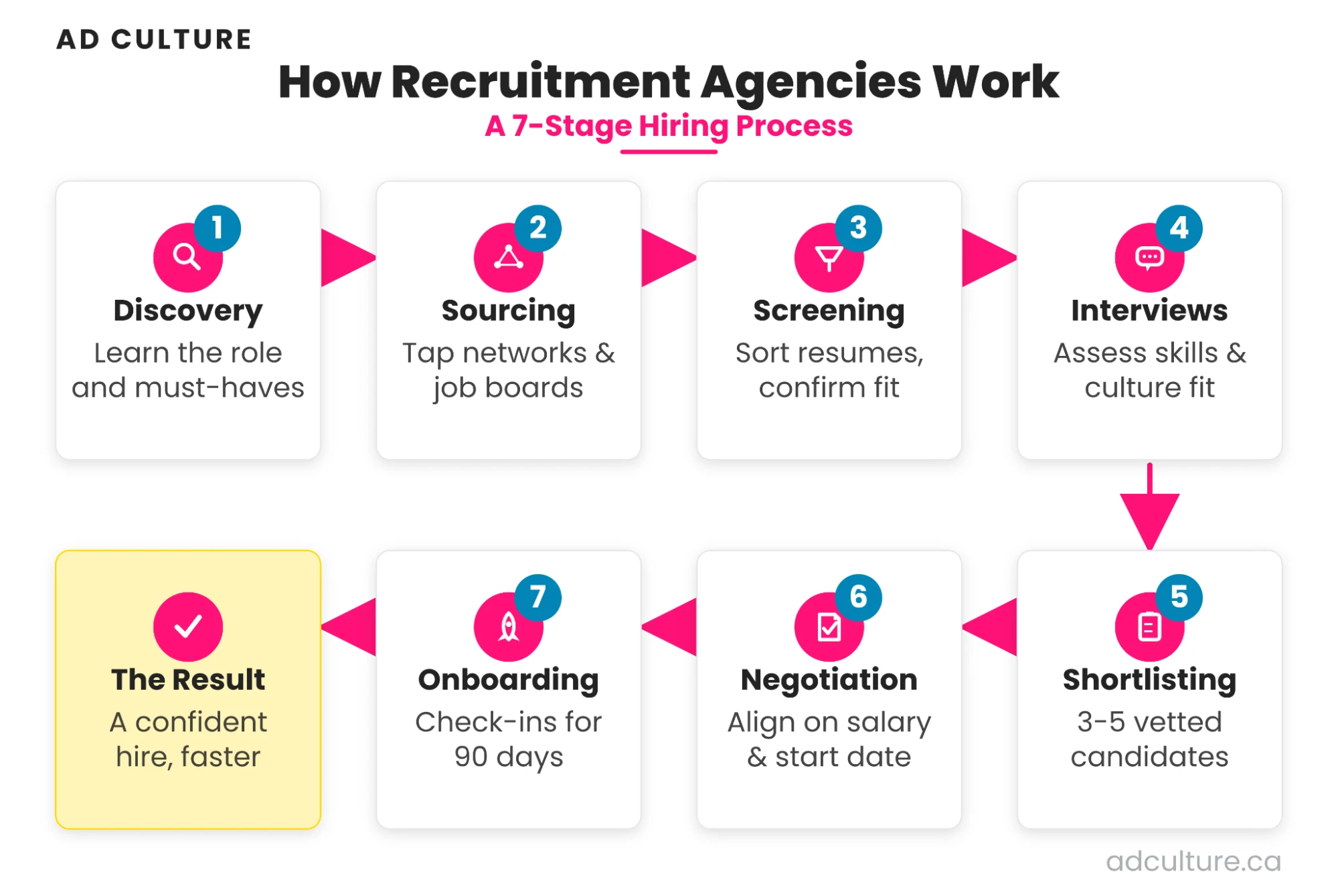
Source: Gemini
1. Discovery and Role Exploration
This is the stage where the agency learns everything about the role (from the employer) or the candidate (from the job seeker) before any matching starts.
From that conversation, the agency builds a clear job description (no worries if you don’t have one yet), a candidate profile, and a plan for where and how to find the right person, usually with a timeline attached.
- Employers decide which positions to fill and get the agency up to speed on the role, the team, and the culture. You should have a sense of the specialized skills or qualifications you’re after. If you don’t, a recruitment consultant can help you get there.
- Job seekers typically have an intro call or complete a profile outlining their experience, skills and what they’re looking for in their next role.
The more specific each side is here (target salary, must-haves, deal breakers), the better the matches and the fewer mismatched opportunities you’ll be sent later.
Note: This is where our Discovery Call and Role Exploration steps come in. We take two passes at this: first, getting to know your company and the role, then getting specific on exactly who we’re looking for.
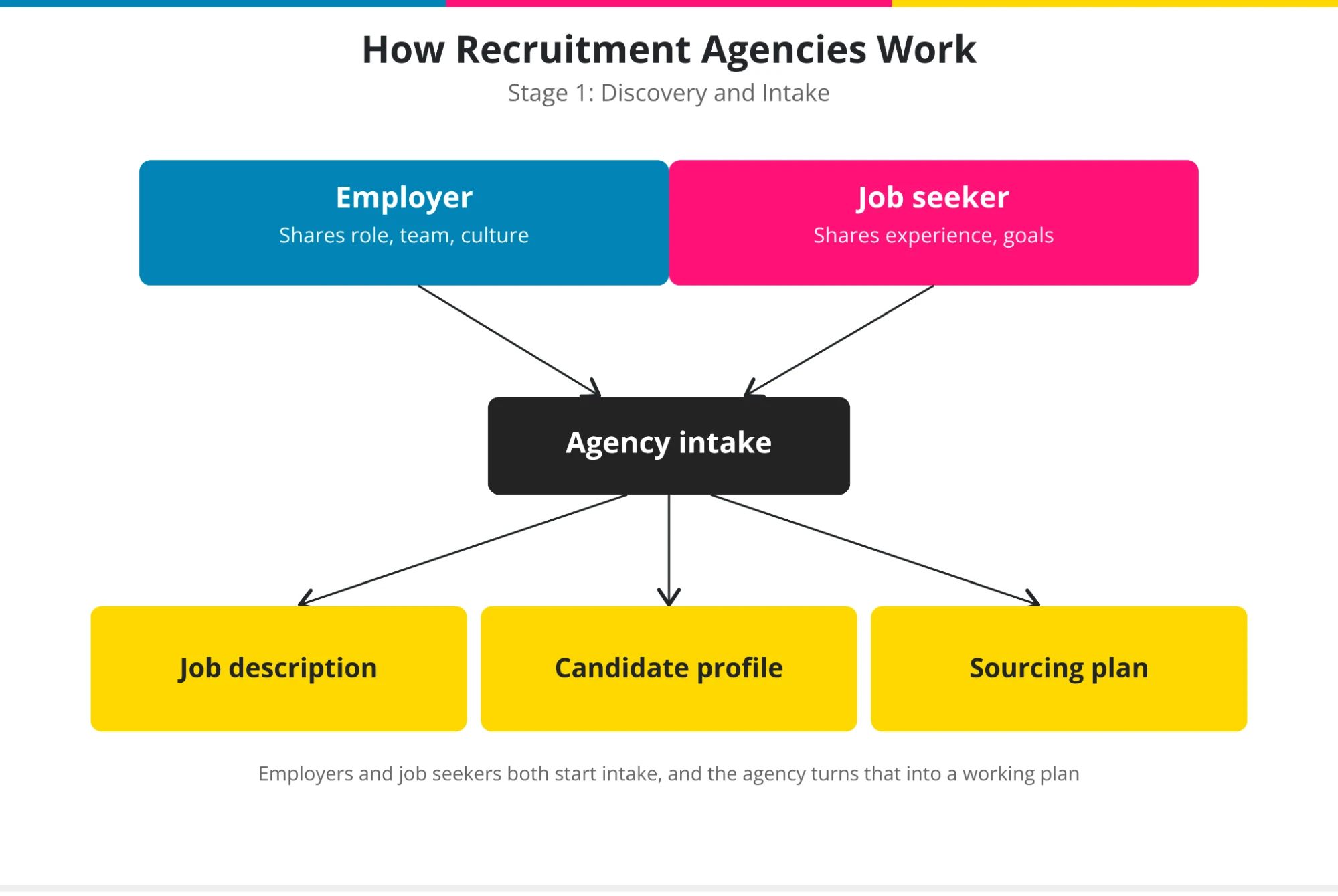
Image Source: Claude, 2026
2. Sourcing
After intake is completed, the agency begins finding the right people, normally starting with its own network and then expanding to job boards (LinkedIn or Indeed), referrals, and direct outreach.
For marketing-specific roles, that might mean scanning portfolios or professional associations. They may also headhunt talent if there aren’t enough suitable candidates.
- Employers are mostly hands-off here as the agency takes the wheel.
- Job seekers can land in the pipeline even without applying to the agency directly by spotting the posting on LinkedIn or Indeed, or simply being on file from a past search when a fitting role opens up.
Note: This is our Review Existing Database & Contacts step, followed by Outreach & Headhunt New Prospects. We check our own network first. If that doesn’t turn up the right fit, we keep looking.
3. Screening
After collecting candidates, recruitment agencies review resumes and select the top matches to move forward.
Sorting applications is what strains in-house human resource teams the most, especially as AI-generated resumes drive up application volume.
Recruitment agencies absorb that load using a combination of software (to manage volume) and a human recruiter skilled in vetting candidates (to judge fit). This process also helps guard against the bias that creeps in when hiring leans too heavily on keyword matching.
- Employers are still mostly hands-off.
- For job seekers, this is where you first hear from a recruiter, whether you applied to a posting or got a cold outreach based on your profile.
Tip: Some agencies may run a quick phone or video screen with candidates to confirm interest, availability, and basic fit, especially if you’re new to their database.
4. Interviews/Assessments
Once a candidate passes screening, the agency runs first-round interviews, usually within a few days of the screen, to keep momentum going.
For marketing roles, this step often includes (or is followed by) a portfolio review or a short skills assessment. Marketing candidates come from such a wide range of backgrounds and specialties that it’s hard to judge fit from a resume alone.
Interviews come down to two things: does this person have the skills, and will they fit your team’s culture?
If the role requires it, background checks and reference calls usually happen around here too, confirming employment history and credentials, which is especially helpful when comparing candidates for the same role side by side.
- Employers stay hands-off here, too. The agency runs the point on interviews and assessments.
- Job seekers who work with recruitment agencies will get interview prep covering a heads-up on what to expect, what each interviewer tends to focus on, and what to have ready to show (portfolio, case studies, numbers).
Note: This is our Interview & Mini Project step. For marketing roles, the mini project often replaces (or backs up) a standard skills test. It’s a real sample of how someone thinks and works, not just what they say in an interview.
The format still depends on the role: a web designer might walk through a portfolio and a live design exercise, while a content writer might be asked for writing samples or a short test assignment.
5. Shortlisting
After interviews and assessments wrap up, the agency narrows everything down to a shortlist (usually three to five candidates) and hands it over with notes on strengths, fit, and anything worth flagging.
Recruitment agencies work at this stage to introduce each candidate directly, whether through a written summary, a quick call, or setting up the first meeting between the employer and the candidate, so neither is walking in cold.
- Employers pick back up here: reviewing the shortlist and running final-round interviews.
- Job seekers who make the shortlist have cleared the agency’s vetting and are heading straight to the employer for a final decision. They can still lean on the recruiter for final-round prep or advice if they want it.
Note: Recruiters like Ad Culture also help candidates vet employers so the fit checks out both ways. If candidates have questions about the role, team, or company that didn’t come up earlier, this is a good time to raise them before the employer makes an offer.
6. Offer Negotiation
Once you’re ready to make an offer, recruitment agencies can act as the go-between on salary, start date, and other terms.
They guide employers on the market rates for their job vacancies and support candidates in salary negotiations. That said, not all agencies handle this stage the same way.
Some just make the introduction and step back once it’s time to talk numbers, while others stay involved through the whole negotiation, passing offers back and forth until both sides agree.
- Employers get a buffer during back-and-forth, keeping negotiations professional even when the numbers don’t align right away.
- Job seekers get an advocate who knows the role’s worth and pushes for fair terms on their behalf.
7. Onboarding Support
Once the candidate accepts the offer, the agency’s role shifts from “finder” to “retention partner.” They help ensure the first 30 to 90 days go smoothly so the hire sticks and both sides feel it was the right call.
Agencies typically support onboarding by:
- Confirming start date, paperwork, and who the new hire should meet in week one.
- Checking in after set intervals to confirm that expectations, role scope, and day-to-day realities line up with what was discussed.
- Stepping in for issues like unclear roles, culture mismatches, or onboarding delays. (For contingency and retained placements, the agency manages replacement guarantees if the fit fails.)
At this point:
- Employers get an extra layer of risk management: problems that might otherwise lead to an early resignation are caught and addressed while they’re still fixable.
- Job seekers get a neutral point of contact if the role doesn’t match the description, plus an advocate for role clarity, training, tools, or even a graceful exit if the fit truly isn’t right.

Employer Costs And Fee Models
Employers usually pay a percentage of the candidate’s first-year salary, a flat fee per placement, a markup over a worker’s pay rate for temporary jobs, or an ongoing retainer for recruiting done at volume.
The fee structure an agency uses affects more than just what you pay: it shapes how fast they move, how much attention your search gets, and how deep they’ll dig. Here’s how the main models break down:
- Contingency. The agency only gets paid if they place a candidate who’s hired and stays past a guarantee period (usually 60 to 90 days, though it varies). Fees typically run 15% to 25% of the candidate’s first-year salary.
There’s no upfront cost, so employers often use several agencies at once, and candidates may be presented for multiple roles in parallel. - Retained search. The employer pays the fee upfront, usually in thirds (at kickoff, shortlist, and placement), to secure the agency’s dedicated attention. The percentage exceeds the contingency, since you’re paying for exclusivity and a deeper search, which is often necessary for senior, executive, or hard-to-fill roles.
- Flat fee. Instead of scaling with salary, the agency charges a fixed dollar amount per placement. This tends to suit repeatable, mid-level roles where a percentage-based fee would feel disproportionate to the work involved.
- Recruitment Process Outsourcing (RPO). This is when recruitment agencies act as an extension of your internal hiring team, handling part or all of your recruiting on an ongoing basis. They charge a recurring retainer or per-hire rate. Best for: companies hiring frequently.
- Staff augmentation or temp agencies fill short-term assignments, contract roles, or contract-to-hire positions. Temporary staffing agencies don’t charge a placement fee. Instead, they charge a markup on top of the worker’s pay rate for the worker. They act as the employer of record, so the markup covers payroll, benefits, and overhead.
Note: Niche recruitment agencies such as Ad Culture, which specialize in marketing talent, usually employ a blended or consultative model, favoring retained search for senior or hard-to-fill roles and contingency for faster, lower-risk placements.
Benefits of Working with a Recruitment Agency
Recruitment agencies save employers time by sourcing and screening candidates, while giving job seekers access to roles, feedback, and support they wouldn’t get when applying on their own. The exact benefits depend on whether you’re on the hiring side or the side being hired.
| Benefits for employers: | Benefits for employees: |
|
|
Let’s chat
about building
your team!
FAQs
No. Employers pay recruitment agencies, not candidates. If anyone asks you to pay for access to job opportunities or interviews, treat that as a red flag.
Recruitment agencies tend to specialize in permanent recruitment. A staffing or employment agency specializes in short-term, contract, or contract-to-hire positions.
Staffing agencies work like recruitment agencies, but for short-term, contract, or contract-to-hire roles instead of permanent placements.
Staffing agencies vet and source candidates the same way and often act as the employer of record for each temporary employee, taking on payroll, benefits, and taxes for the length of the assignment. Since the agency handles payroll, employers pay a markup on the worker’s pay rate instead of an up-front placement fee.
Timelines vary by role: entry-level and general positions typically take two to four weeks, while specialized or senior searches can run six to twelve weeks or more, depending on how niche the role is and how deep the candidate pool goes.
Key Takeaways
- Recruitment agencies match employers with qualified candidates (and help job seekers find best-fit roles).
- Employers save time on job posting, advertising, resume screening, and initial interviews.
- Job seekers get support with resumes, interview prep, and guidance on what hiring managers want.
- The process: define the role → agency advertises → screens/interviews → delivers a shortlist for final decisions.
- Agencies can continue searching if the first match isn’t right and may also support salary negotiations and onboarding steps.
Need a Recruitment Agency? Ad Culture Is the Answer
No matter which side of the hiring process you’re on, a recruitment agency makes it easier. Whether you’re chasing a role where your skills will thrive or trying to fill a seat with someone who can hit the ground running, working with one is the move.
So, how do recruitment agencies work? You’ve got the full answer now. Ad Culture is ready to put it to work, whether that means finding your dream job or your next top-tier hire.
With our team in your corner, you’ll make the right connections in no time.