
How to Write an Equal Opportunity Employer Statement (+Examples)
 By Stephen Pedder
 A strong equal opportunity employer statement covers five things: your stance as an equal opportunity employer, who is protected, which employment practices it applies to, accommodation language, and why inclusion matters to your company. The best ones sound human and brand-aligned.
Organizations often include an equal opportunity employer statement in their job listings to demonstrate their commitment to creating an inclusive and empowering workplace. But, as an employer, how can you craft an effective equal employment opportunity (EEO) statement?
In this article, we’ll discuss what makes a compelling EEO statement to help you attract and hire diverse candidates. Let’s get started.
What Is an Equal Opportunity Employer Statement?
An equal opportunity employer statement is a short, formal declaration that your company will not discriminate against candidates or employees based on legally protected characteristics, such as race, ethnicity, national origin, veteran status, gender, religion, disability, or sexual orientation.
In short, it’s your public commitment to fair and unbiased hiring.
→ Learn more: What Is an Equal Opportunity Employer?
Are EEO Statements the Same in Canada and the US?
No, EEO policy statements aren’t quite the same in Canada and the US. They share the same goal, but the rules behind them differ.
- In the US, EEO statements are shaped by federal law and enforced by the Equal Employment Opportunity Commission (EEOC). The obligation stops at non-discrimination; there’s no federal requirement to actively recruit or advance underrepresented groups.
- An equal opportunity employer statement in Canada follows the Canadian Human Rights Commission (CHRC). Employers are expected to actively promote inclusion for four designated groups: women, Indigenous Peoples, persons with disabilities, and members of visible minorities.
Where Should You Include an EEO Statement?
Your EEO statement should be included in all:
- Job listings
- Company websites/career pages
- Employee handbook (as part of the equal employment opportunity policy)
- Offer letters and onboarding materials
Is an EEO Statement Required?
In the US, only federal contractors are legally required to include one. In Canada, federally regulated employers are subject to the Employment Equity Act, which requires formal equity reporting and a workforce obligation on top of a standard statement.
Everyone else may not be required, but they must still comply with federal anti-discrimination laws. Either way, an EEO statement is still worth it, since it signals fair hiring to candidates and can protect you if a discrimination complaint ever arises.
How Long Should an EEO Statement Be?
There’s no legal minimum or maximum length, but shorter is usually better for job postings. One to three sentences works for most. Save the details for your full EEO policy in your employee handbook, and link to it from your job posting if candidates want to read more.
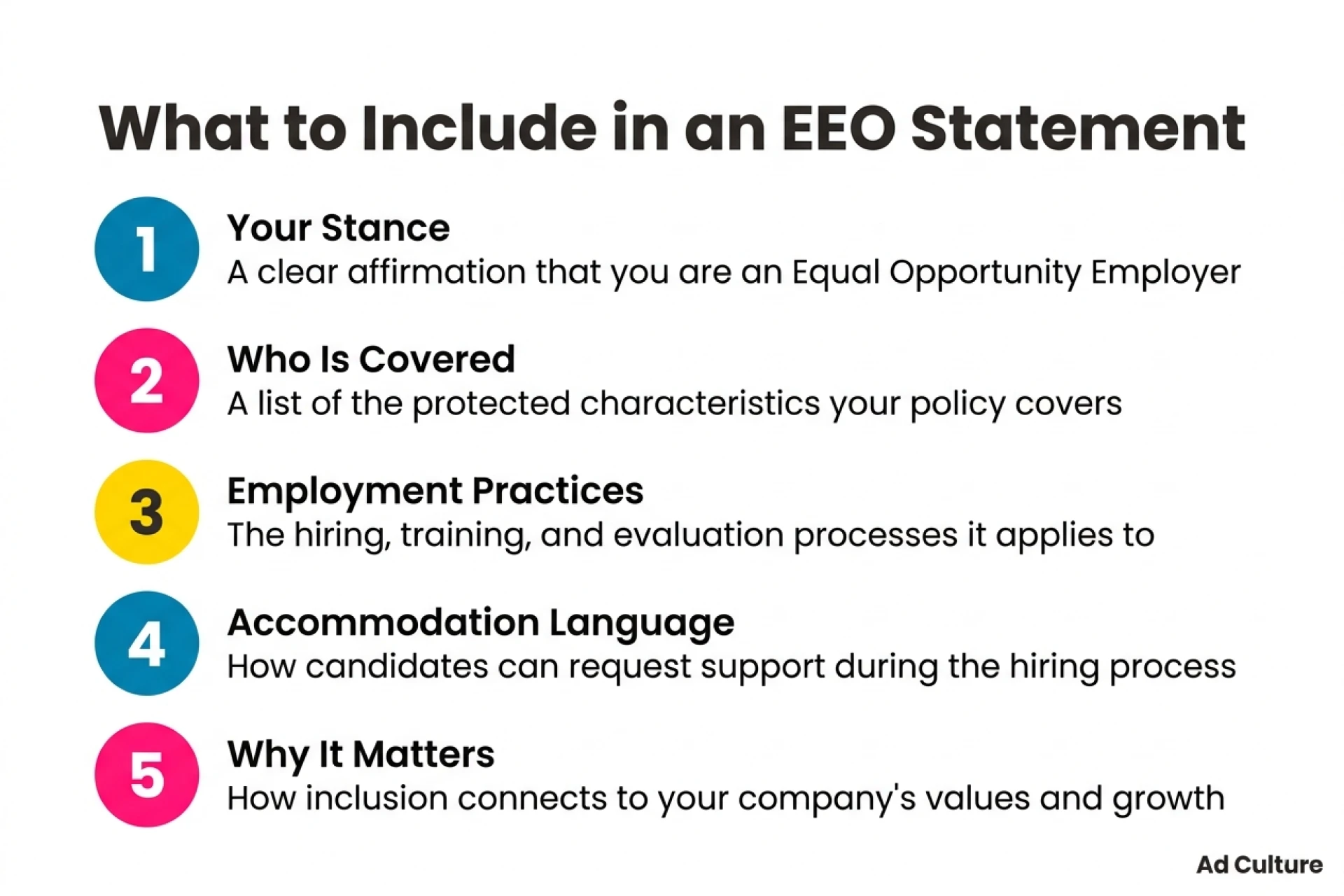
Image Source: Gemini, 2026
What Should You Include in an EEO Statement?
A strong EEO statement covers five things:
- your stance as an equal opportunity employer,
- who is protected under your policy,
- which employment practices it applies to,
- accommodation language for candidates who need it, and
- why inclusion matters to your company.
The more specific you are on all five, the more credible it reads. Let’s dive into each one below.
1. Your Stance/Affirmation of Status
Start with a clear, direct affirmation that tells the reader where you stand. You can simply say “We are an Equal Opportunity Employer” or customize to reflect your brand voice.
- For example, Google’s EEO opener expands slightly, saying: “Google is proud to be an equal opportunity and affirmative action employer.”
- Netflix, meanwhile, ties it to a business belief: “We are an equal-opportunity employer and celebrate diversity, recognizing that diversity builds stronger teams.”
- On Pathward’s job listings, they go further, weaving inclusion into their identity: “Our commitment to inclusion is woven into our DNA. We believe that we are strongest when we embrace the voices of our employees, customers, partners, and the communities we serve.”
| Tip: EEO statements are legal documents at heart, so it’s easy to default to stiff, formal language, but candidates read them too. The goal is to sound compliant and human. If your careers page has a distinct voice, your EEO statement should feel like it belongs there. |
2. Who Is Covered (Non-Discrimination List)
Explicitly say you don’t discriminate, then list the protected characteristics your policy covers. When job applicants see their identity reflected in your statement, they’re more likely to trust your company and apply.
Many companies take a “kitchen sink” approach to this, listing every protected characteristic explicitly. For example, Dell’s statement leaves virtually nothing out. Here’s their equal opportunity employer statement sample for your reference:
“All employment decisions at Dell are based on business needs, job requirements and individual qualifications, without regard to race, color, religion or belief, national, social or ethnic origin, sex…or any other status protected by the laws or regulations in the locations where we operate.”
🚩Let’s be clear: A list of protected characteristics is the floor, not the ceiling. You risk boring your candidates to death if you lead with legalese and nothing else. Instead, anchor your statement in values and voice.
3. Which Employment Practices Apply
Your statement should make clear that equal opportunity applies not only to the hiring process but also to all employment practices in your company.
Call out employment aspects, such as your recruitment and training processes or what candidates can expect once they’re hired.
For instance, Asana’s EEO statement does this well:
“…Decisions related to hiring, compensating, training, evaluating performance, or terminating are made fairly, and we provide equal employment opportunities to all qualified candidates and employees.”
Under Armour takes a similar approach but leads with culture first:
“Under Armour believes that diversity and inclusion among our teammates is critical to our success as a global company, and we seek to recruit, develop and retain the most talented people from a diverse candidate pool.”
Tip: Notice that both statements name specific practices rather than using vague language like “all aspects of employment.” Be precise and avoid vague terms to leave no room for interpretation. The more concrete you are, the more credible your commitment reads.
4. Accommodation Language
Include a clear line stating that reasonable accommodations are available during the hiring process. In Ontario, this is required under the Accessibility for Ontarians with Disabilities Act (AODA).
If you’re writing an equal opportunity employer statement for Canada, try combining your EEO commitment and accommodation language in one paragraph, as KUBRA does:
“KUBRA is an equal opportunity employer dedicated to building an inclusive and diverse workforce. We will provide accommodations during the recruitment process upon request. Information received relating to accommodation will be addressed confidentially.”
Notice what makes it work: it’s specific, discreet, and tells candidates exactly what to expect.
Tip: Avoid vague language like “we support accessibility.” Name a contact method so there’s no barrier to asking. For internal policies, you can include how employees or applicants can report discrimination or harassment.
5. Why It Matters to Your Company’s Growth & Work Culture
An effective equal employment opportunity statement focuses on the work culture and employer branding you’re trying to create. Highlight how diversity and inclusion align with your company’s core values and why they matter to your growth.
Make it clear that it’s important to your company’s growth and development, just like these brands:
- Textio keeps it simple and business-focused: “The more inclusive we are, the better our work will be.”
- Cisco Meraki ties it to innovation: “When we connect different perspectives, we can imagine new possibilities, inspire innovation, and release the full potential of our people.”
- Nintendo leads with values: “We offer a welcoming and inclusive environment in service to one another, our products, the diverse consumers we represent, and the communities we call home. We do all of this with kindness, empathy and respect for each other.”
The best EEO statements answer one question candidates are really asking: “Does this company actually mean it?” If yours can’t, that’s worth addressing internally before it shows up in your job posting.
| How to test an EEO statement’s authenticity?
Ask these three questions to see how your EEO statement fares:
|
Beyond the EEO Statement: Ontario’s 2026 Job Posting Requirements
As of January 1, 2026, the Ontario Employment Standards Act (ESA) requires Ontario employers with 25 or more employees to include new disclosures in every publicly advertised job posting:
- a compensation range,
- a statement on whether the role is an existing vacancy, and
- whether AI is used to screen or assess applicants.
That means your EEO statement now sits alongside these disclosures. So, aside from your inclusion and diversity policies, you’ve got more boxes to check, but also more ways to stand out.
⚠️Non-compliance and violations of the ESA can result in fines, penalties, and compliance orders.
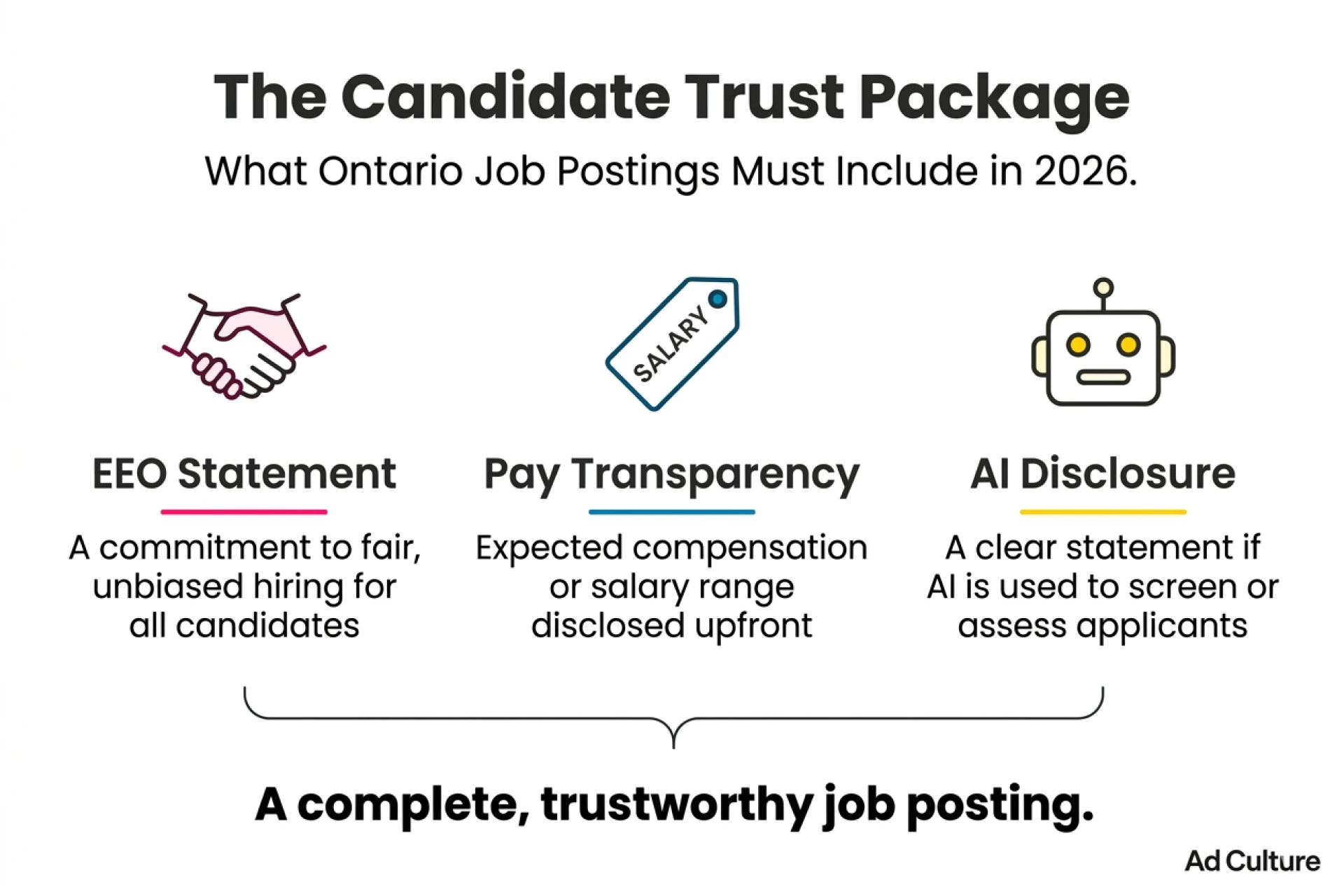
Image Source: Gemini, 2026
In Summary
- An EEO statement is a formal declaration that your company will not discriminate against candidates or employees based on legally protected characteristics.
- It’s one of the first signals candidates use to decide if your company is worth their time.
- A strong one covers five things: your stance, who is covered, which employment practices it applies to, accommodation language, and why inclusion matters to your company.
- The more specific you are on all five, the more credible it reads.
- If you’re in Ontario with 25+ employees, your job posting now also requires pay transparency, AI disclosure, and vacancy status.
Put Your EEO Statement to Work With Better Recruitment
Writing a strong EEO statement is the first step; building a team that reflects it is the next.
Ad Culture is a leading recruitment agency that connects recruiters with talent from the advertising, marketing, and communications industries. We’ll help you find the best candidates who fit your role, your culture, and the values behind your equal opportunity employer statement.
We’re ready when you are. Contact us and let’s create a diverse and inclusive workplace today!